

OneDoc: Ask Doki
Enhancing Healthcare Access with GenAI-empowered Booking Assistance
Abstract
Streamlining patient-doctor connections
In response to growing needs for accessible healthcare services, OneDoc, a platform connecting patients with healthcare providers, sought to improve the appointment booking experience and medical information access for its users. Partnering with the Swiss Data Science Center (SDSC), OneDoc developed a proof-of-concept called "Ask Doki," an AI-powered assistant that guides patients through finding appropriate specialists, scheduling appointments, and answering medical queries.
Healthcare access often involves navigating complex symptom-specialty relationships and appointment booking processes. “Ask Doki” addresses these challenges by creating a conversational interface that simplifies these interactions through natural language processing.
People
Collaborators
Clément Lefeebvre joined the SDSC in January 2019 as a Data Scientist with an emphasis on industry-oriented projects in the Innovation team, based in Lausanne.
He holds a Bachelor of Science degree in Physics, acquired in 2016 from the École Polytechnique Fédérale de Lausanne (EPFL) in Switzerland. Following this, he earned a Master of Science in Computational Science and Engineering in 2018, also from EPFL. Throughout his academic journey, Clément concentrated on leveraging Data Science and Machine Learning techniques to enhance efficiency in industrial processes. Subsequently, he developed a specialized interest in Generative AI, with a particular focus on Natural Language Processing (NLP), especially in the application of Large Language Models for innovation.


Thibaut holds a B.Sc in Computer Science from HEIG-VD. Before joining the SDSC, he worked in startups where he developped a diverse skill set combining cloud infrastructure, database and application development. Thibaut is very enthusiatic about new technologies and best coding practices and he is looking forward to supporting the team and its projects.

Alessandro joined the SDSC in March 2019 as a data scientist focused on industry collaborations. His mission is to support corporates in leveraging the power of their data by adopting analytical approaches and data-centric solutions. His background is in biomedical engineering, with a PhD in neuroscience from the University of Tübingen. Before joining the center, he worked as a postdoc at the Max Planck Institute for Biological Cybernetics, at the EPFL Laboratory of Cognitive Neuroscience in Geneva, and as data scientist for a private ecommerce company.
description
Challenge: Building an intuitive healthcare navigation system
OneDoc needed an intuitive system capable of:
· Interpreting patient-described symptoms and recommending appropriate medical specialties
· Facilitating appointment booking based on patient location and doctor specialization
· Answering medical questions using verified medical literature
· Providing information about OneDoc services through FAQ-based knowledge
From concept to AI: A multi-agent system
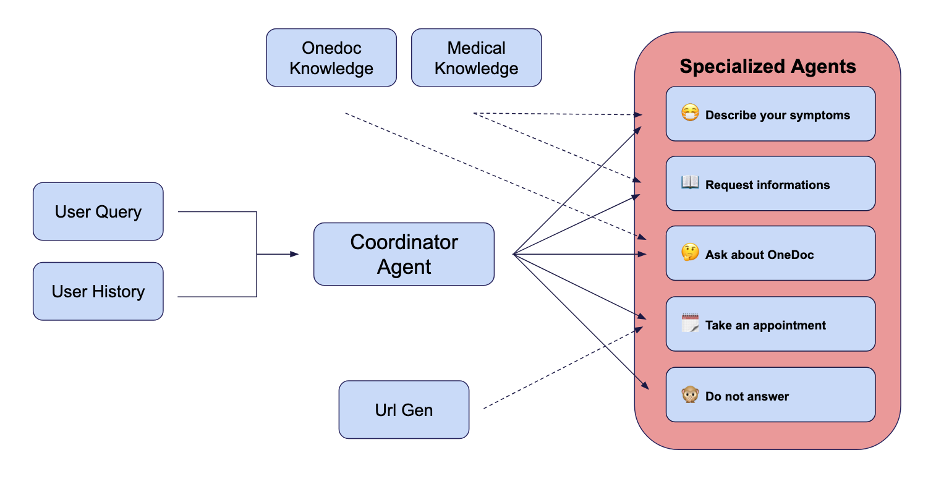
Leveraging expertise in large language models (LLM) and healthcare systems, the SDSC team developed "Ask Doki," a solution powered by state-of-the-art LLMs implemented as a Hierarchical Multi-Agent System (HMAS). This innovative architecture supports complex decision-making and reliably guides patients through healthcare navigation.
Key features of the solution include:
· Intelligent symptom analysis: The assistant interprets patient-described symptoms and recommends appropriate medical specialties, ensuring patients connect with the right healthcare providers. This reduces the common patient challenge of determining which type of specialist to consult for specific health concerns.
· Natural language appointment scheduling: By understanding patient location preferences and specialist requirements through conversational interactions, “Ask Doki” streamlines the appointment booking process without requiring form-based inputs. Patients can express their needs conversationally, such as "I need a dermatologist near Lausanne."
· Medical information retrieval: Using a sophisticated Retrieval-AugmentedGeneration (RAG) system, the assistant provides accurate medical information sourced from verified literature, along with citations for transparency. This grounding in reliable sources helps prevent the spread of medical misinformation while providing patients with trustworthy guidance.
· Service information: “Ask Doki” offers comprehensive information about OneDoc's services by leveraging the platform's FAQ as a knowledge base. This integration ensures consistent and accurate responses about platform features, policies, and procedures.
· Hierarchical agent coordination: The system uses specialized agents organized in a hierarchical structure, with a coordinator agent determining which specialized agent should handle each user query, creating a seamless experience across multiple use cases.
Technical implementation
The Hierarchical Multi-Agent System architecture represents an innovative application of LLM technology in healthcare. By implementing a coordinating agent that delegates tasks to specialized agents for different functions (symptom analysis, appointment booking, medical information retrieval, etc.), the system creates a unified interface that feels naturally conversational while performing complex background processes.
This architecture allows each specialized agent to excel in its specific domain while maintaining a coherent user experience. The coordinator agent acts as an intelligent router, analysing user intent and directing queries to the appropriate specialized agent without requiring users to explicitly select different modes or interfaces.
For the medical information retrieval system, special attention was given to the citation mechanism.
When providing health information, “Ask Doki” clearly identifies the source material, allowing users to verify information and healthcare providers to assess the credibility of recommendations. This transparency is crucial for building trust in AI-powered healthcare solutions.
Impact
The “AskDoki” prototype demonstrates how AI can transform healthcare access by creating intuitive interfaces between patients and medical systems. By simplifying scheduling and offering trustworthy medical support, the solution tackles major barriers in the healthcare journey.
The implementation of a Hierarchical Multi-Agent System in this context showcases how conversational AI can move beyond simple chatbots to offer a comprehensive service navigation. This solution simplifies the experience, sparing patients from having to learn complicated tools and interfaces or to understand the underlying structure of healthcare systems.
By implementing citation mechanisms for medical information, “Ask Doki” maintains transparency and builds trust with users, ensuring they can verify the sources behind recommendations. This responsible approach to AI in healthcare establishes a model for how complex systems can be made accessible while maintaining high standards of accuracy and accountability.
This effort highlights how language models, when used thoughtfully and responsibly, can serve as a bridge between patients and complex healthcare infrastructures - setting the stage for further AI innovation in healthcare.
Presentation
Gallery
Cover image source: Adobe Stock
Annexe
Additional resources
Bibliography
Publications
Related Pages
· OneDoc: https://www.onedoc.ch
More projects
Merck: cancer care adverse events
Èvokâ: Enhancing Fribourg's Archives
ACROSS

Dedgeflow
More projects
News
Latest news

La science des données au service de la neutralité carbone du canton : ENERBAT ouvre la voie
La science des données au service de la neutralité carbone du canton : ENERBAT ouvre la voie
The SDSC to support 31 projects through its second National Calls
The SDSC to support 31 projects through its second National Calls
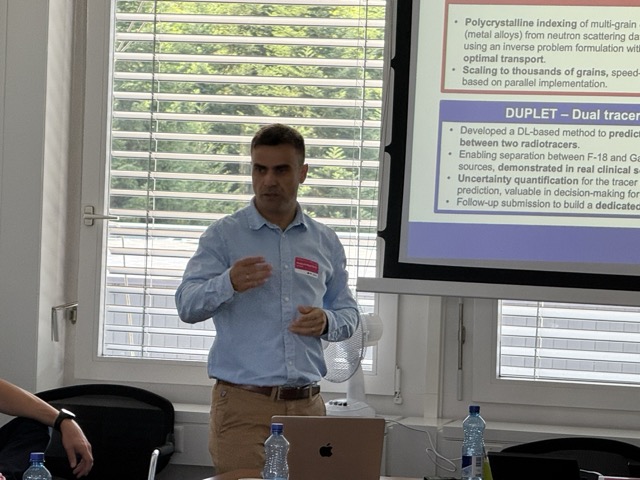
SDSC and PSI teams jointly explore the AI potential of large-scale infrastructures
SDSC and PSI teams jointly explore the AI potential of large-scale infrastructures
Contact us
Would you like to explore how we can work together?
Our team of data scientists and professionals looks forward to engaging in impactful, results-driven collaborations with you.