

NWF4CH: Neural Weather Forecasting
Democratizing Neural Weather Forecasting for Switzerland (NWF4CH)
Abstract
Objective
The NWF4CH project aims to make state-of-the-art global AI weather forecasts useful at the regional and local scale, with a particular focus on Switzerland. Recent global AI weather models (such as ECMWF's AIFS) generate skillful medium-range forecasts at a significantly lower cost than conventional numerical weather prediction (NWP) methods. However, their native horizontal resolution of about 25–30 km proves too coarse for many local applications, particularly over complex terrain where precipitation varies sharply across just a few kilometers. NWF4CH intends to bridge this gap by providing both a methodological framework (custom downscaling models for specific variables) and an open platform allowing the community to evaluate and showcase their own regional AI forecasts.
The methodological framework, named SwAIther-Precip, focuses on the precipitation case: producing kilometer-scale, probabilistic precipitation forecasts over Switzerland, out to medium-range lead times.
People
Collaborators

Federico holds a M.Sc. in Engineering and a Ph.D. in Sustainable Development and Innovation Engineering. After a three-year Postdoc in Environmental Data Mining at the University of Lausanne, in 2021 he joined the Swiss Data Science Centre, where he now works as Principal Data Scientist supporting the acceleration of the digital transformation within industries, NGOs and public bodies. Over the years he worked on the development of methodological tools to mine and model big spatiotemporal datasets. He has deep competencies in applied statistics, machine learning, geocomputation, spatial statistics, remote sensing.


Dan received an MSc in civil and environmental engineering from UC Berkeley and a Ph.D. from EPFL, where he developed models combining machine learning and geographic information systems to estimate renewable energy potentials on a large scale. After serving as a researcher/data scientist at Unisanté (Lausanne) and completing a one-year postdoc at the Quebec Artificial Intelligence Institute (Mila) in Montréal, Dan joined the SDSC Innovation team. His work has generally been focusing on crafting and tailoring machine learning methods and deep learning architectures for a variety of domains, most notably the spatio-temporal modeling and forecasting of environmental and energy related variables, as well as multiple applications in public health research.

Thibaut holds a B.Sc in Computer Science from HEIG-VD. Before joining the SDSC, he worked in startups where he developped a diverse skill set combining cloud infrastructure, database and application development. Thibaut is very enthusiatic about new technologies and best coding practices and he is looking forward to supporting the team and its projects.

Kyle (Hogir) van de Langemheen joined the SDSC in September 2025 as a Machine Learning Engineer in the Innovation team, based in Lausanne.
Kyle holds an MSc in Artificial Intelligence from the University of Groningen. He brings several years of experience applying AI across research and industry.
Outside of his professional interests, Kyle enjoys hiking, reading, cooking, and coffee.
PI | Partners:
Tom Beucler (Faculty of Geosciences and Environment & Expertise Center for Climate Extremes, University of Lausanne)
Erwan Koch (Expertise Center for Climate Extremes, University of Lausanne)
Daniele Nerini (Federal Office of Meteorology and Climatology MeteoSwiss)
description
Approach / Solution
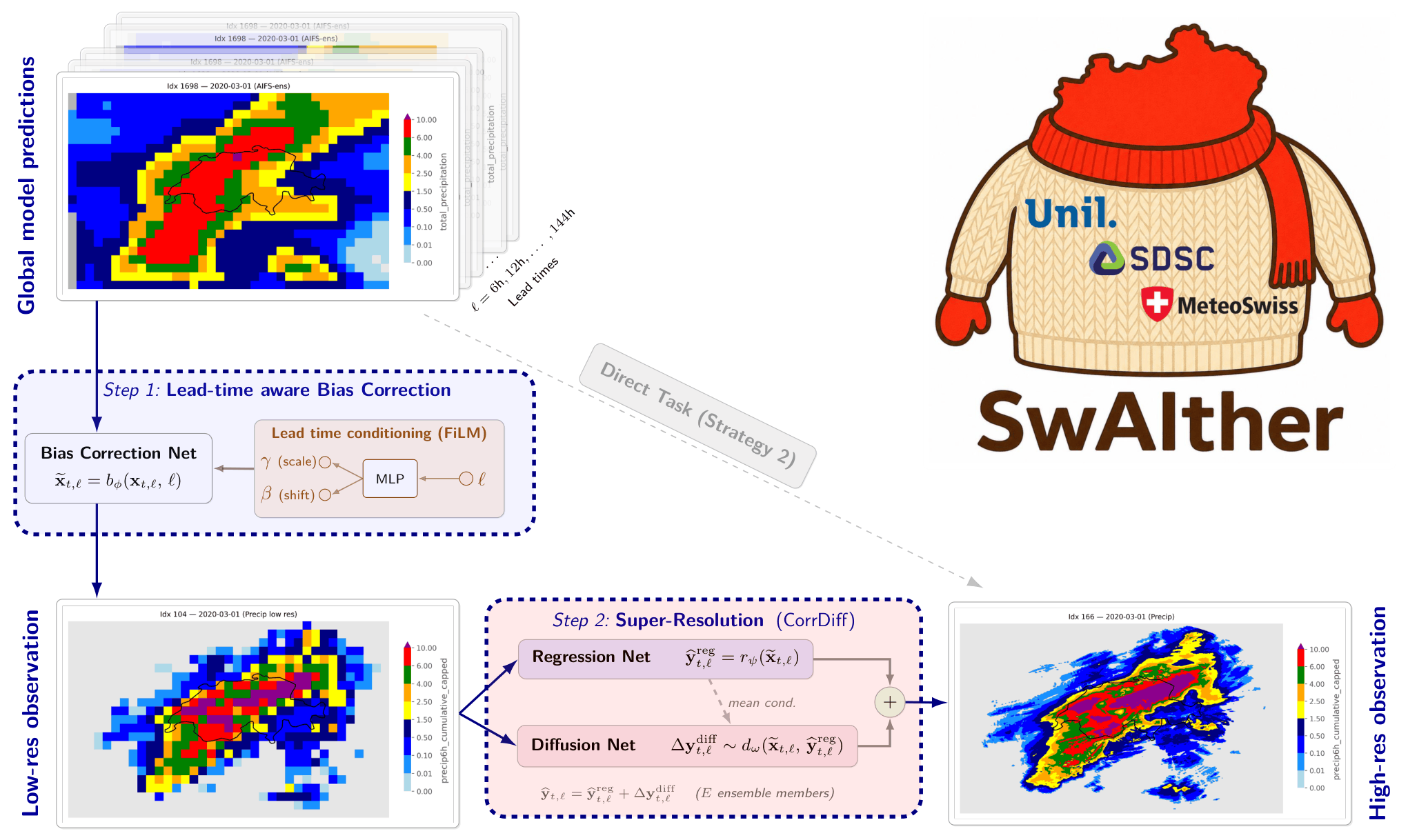
Forecasting precipitation in mountainous regions is challenging because precipitation arises from multiscale, nonlinear processes that global models cannot resolve at an affordable cost. Rather than re-training a regional AI weather model from scratch, SwAIther-Precip post-processes existing AIFS forecasts in two complementary steps :
- The first step is a deterministic bias correction at coarse resolution. A U-Net takes the full multivariate AIFS forecast (precipitation, winds, humidity, temperature, geopotential) and produces a corrected coarse precipitation field. The model is conditioned on forecast lead time through a Feature-wise Linear Modulation (FiLM) mechanism, so a single network handles all horizons from 6 hours to 6 days.
- The second step is a generative super-resolution. A conditional diffusion model (based on NVIDIA's CorrDiff) takes the bias-corrected coarse field, together with topographic information, and generates an ensemble of realistic km-scale precipitation patterns. Because the bias correction has already absorbed lead-time dependence, this step can be trained in a perfect-prognosis setting on observations alone, keeping training costs low and the same model usable across all forecast horizons.
The pipeline was developed and evaluated using AIFS forecasts and the MeteoSwiss CombiPrecip radar–gauge product, an unusually rich combination of operational AI forecasts and high-resolution observational data.
Across all metrics, SwAIther-Precip outperforms both classical post-processing baselines and single step deep-learning alternatives. It reduces the Continuous Ranked Probability Score (CRPS) by 48% relative to raw AIFS and 11% relative to the strongest classical baseline. It also reproduces observed precipitation variance from synoptic to convective scales (effective resolution of ~4 km on a 1 km grid). Multi-horizon training also proves to be more effective than training horizon-specific specialists, particularly at longer lead times.
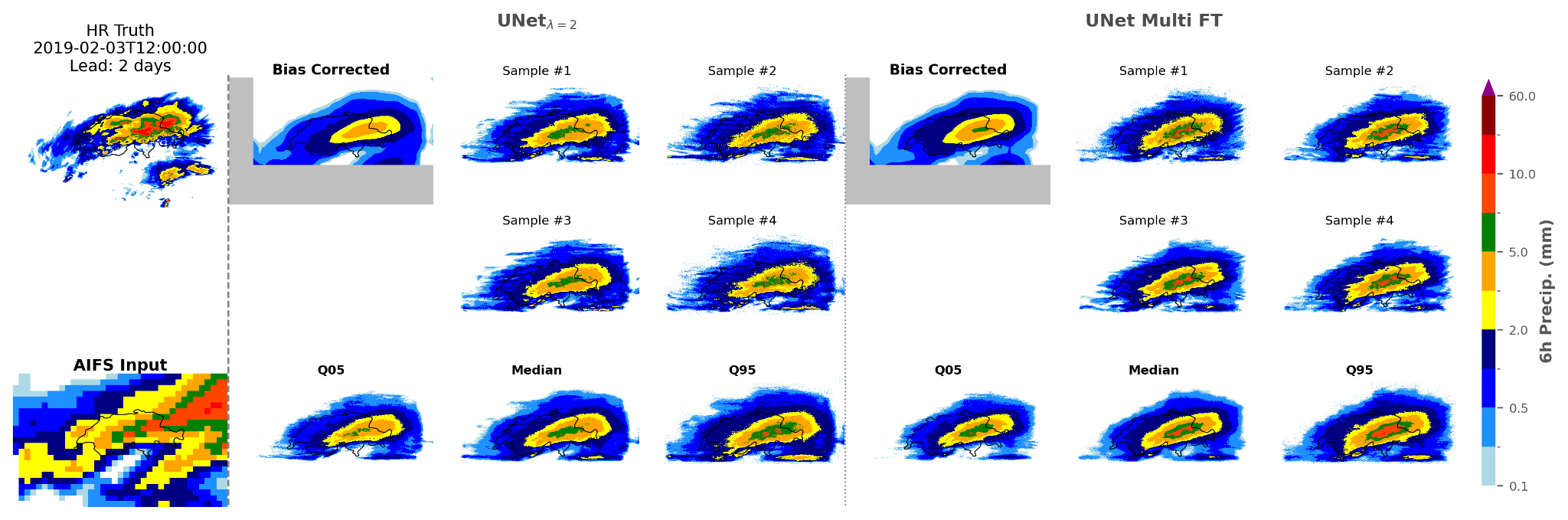
Figure 1: High-resolution precipitation samples generated by the full bias correction + super resolution pipeline for our two SwAIther-Precip variants at a 2-day lead time, for a random time step in the test set.
Impact
SwAIther-Precip demonstrates that lightweight, targeted post-processing of global AI weather forecasts can deliver km-scale, probabilistic precipitation forecasts at significantly reduced cost compared to dynamic regional modeling. This is particularly relevant for operational forecasting agencies and for downstream applications such as flood early warning, hydropower management, agriculture, and infrastructure planning.
The framework is designed to be generalizable: while the present case study is focused on Switzerland, the methodology can easily be applied to other regions and to other global AI driving models, provided sufficiently high-resolution observational data is available for training.
In essence, NWF4CH illustrates the power of collaboration between data scientists, meteorological services, and academic researchers to translate the rapid progress of foundation-scale weather AI into practical tools for national-scale weather services and the broader scientific community.
Presentation
Gallery
Annexe
Additional resources
Bibliography
Publications
Related Pages
Further details of the methodology and results shall be found in the associated ArXiv preprint: Assouline, et al. SwAIther-Precip: Lead-Time-Aware Bias Correction Enables Kilometer-Scale Downscaling of Global AI Precipitation Forecasts over Switzerland. https://arxiv.org/abs/2605.16163
More projects

ALBUM

AICADES

IICU National Data Stream

SMARTT
More projects
News
Latest news

Quand l’IA soutient l’économie du canton de Vaud, la santé et l’environnement
Quand l’IA soutient l’économie du canton de Vaud, la santé et l’environnement

Elevating International Geneva's Impact with AI
Elevating International Geneva's Impact with AI

12 Zurich SMEs join next AI Innovation Program
12 Zurich SMEs join next AI Innovation Program
Contact us
Would you like to explore how we can work together?
Our team of data scientists and professionals looks forward to engaging in impactful, results-driven collaborations with you.