

PhenoMix
Multidimensional field phenotyping of crop mixtures
Abstract
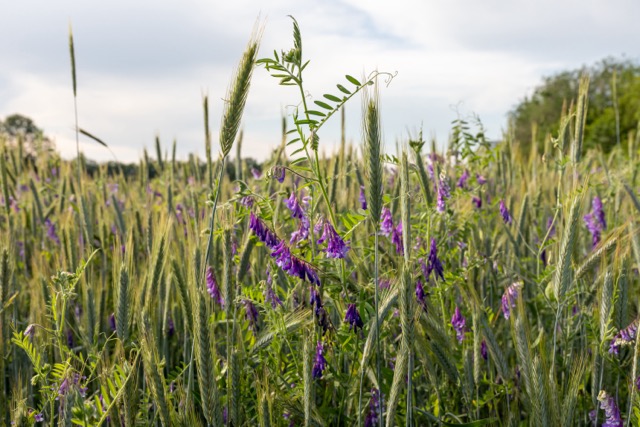
What if growing two crops together could help us produce more food while using fewer resources? Cereal–legume mixtures offer exciting opportunities for more sustainable agriculture, as different species can complement each other. Yet, identifying the species interaction under different climate scenarios remains a major challenge.
Project PhenoMix brings together plant science, computer vision, and artificial intelligence to tackle this challenge. By combining natural images, 3D reconstructions, and environmental data, the project explores how crops grow, compete, and complement each other throughout the growing season. The goal is to develop machine learning methods that automatically extract plant traits and transfer knowledge from specialized phenotyping platforms to more accessible devices, such as drones.
Ultimately, PhenoMix aims to turn complex field observations into actionable knowledge, supporting the selection of suitable crop combinations and paving the way toward more productive, resource-efficient, and climate-resilient agriculture.
This project is supported by the SNSF grant “PhenoMix” no. 10008303.

People
Collaborators

Michele Volpi holds a Ph.D. in Environmental Sciences from the University of Lausanne (2013). He was a postdoctoral researcher in the CALVIN group at the University of Edinburgh’s School of Informatics (2014–2016), and then a member of the Multimodal Remote Sensing and Geocomputation groups at the University of Zurich’s Department of Geography (2016–2017). He joined SDSC in 2018 as Senior Data Scientist in the Research Team and became Lead Data Scientist in 2022. Since 2025, Michele serves as Climate and Environment Domain Lead, overseeing SDSC’s activities in this area. He leads projects in geospatial machine learning, working with Earth observation and geolocated spatio-temporal data, with applications in climate and weather, ecology, natural hazards, and agriculture, among others. Michele is also a Lecturer in the Department of Environmental Systems Sciences at ETH Zurich.



Olivia Zumsteg joined SDSC Research team as a Postdoctoral Researcher in November 2026. She received her PhD from ETH Zurich in 2026, focusing on applied machine learning and computer vision, including the combination of 3D reconstructions with knowledge distillation for the purpose of developing efficient models in plant phenotyping. She also worked with ordinary differential equations (ODEs) and physics-informed neural networks (PINNs) for time series modeling to mitigate the effects of climate change on crop yields.
As a postdoctoral researcher, her research at SDSC focuses on representation learning, probabilistic models, and synthetic image generation, with applications involving images and multimodal sensor data.
PI | Partners:
ETH Zürich
Department of Environmental Systems Science
- Prof. Dr. Achim Walter (Crop Sciences)
- Prof. Dr. Nina Buchmann (Grassland Sciences)
description
Motivation
Climate change and the increasing demand for sustainable food production call for agricultural systems that use resources more efficiently while maintaining high yields. Crop mixtures, particularly combinations of cereals and legumes, offer a promising approach by improving resource use efficiency, biodiversity, and resilience. However, understanding how different crop species and varieties interact under changing environmental conditions remains challenging, especially because traditional phenotyping methods are labor-intensive and difficult to scale. The project seeks to improve our understanding of crop mixtures and support the selection of optimal variety combinations for more sustainable agriculture.
Proposed Approach / Solution
Phenomix focuses on developing machine learning and computer vision methods to enable automated trait estimation and transfer learning for pure crop stands and crop mixtures. The approach plans to explore pretrained foundation models for plant trait extraction, alongside 3D reconstruction and image generation to create realistic synthetic plant images. Domain adaptation techniques facilitate the transfer of models trained on high-quality images from the FIP 2.0 platform (Fig. 1) to more accessible imaging devices, such as drones, while minimizing the need for additional labeled data. Furthermore, human-in-the-loop and active learning strategies incorporate expert feedback to improve model predictions and guide data annotation. The developed methods are evaluated under real field conditions and contribute to comprehensive, multimodal time-series datasets, supporting downstream analyses of crop growth and interactions (Fig. 2).
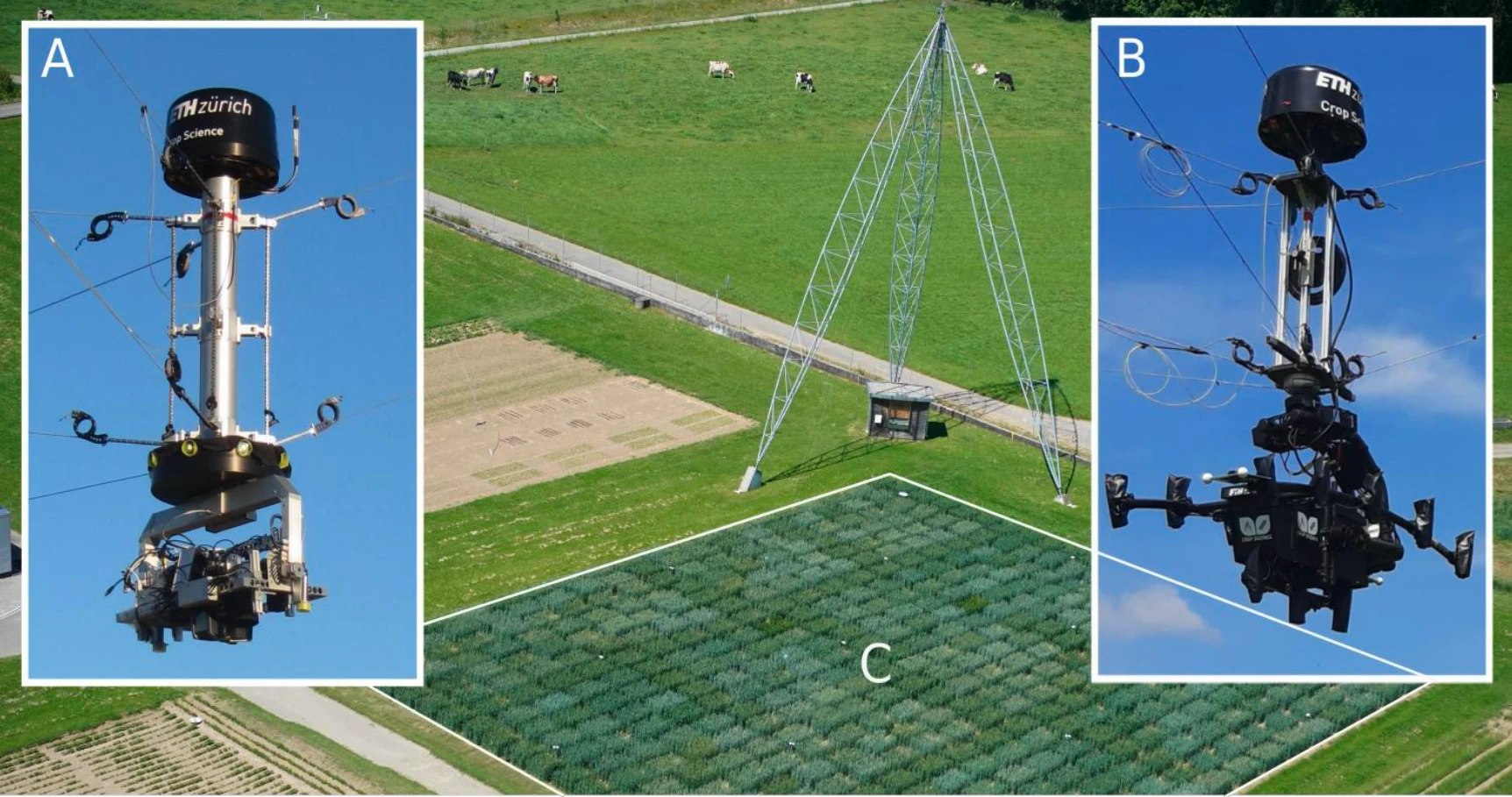
Figure 1: Field phenotyping platform (FIP) with the FIP 1.0 sensor head (A), FIP 2.0 multi-view sensor head (B) and an overview of the field with experimental plots (C).
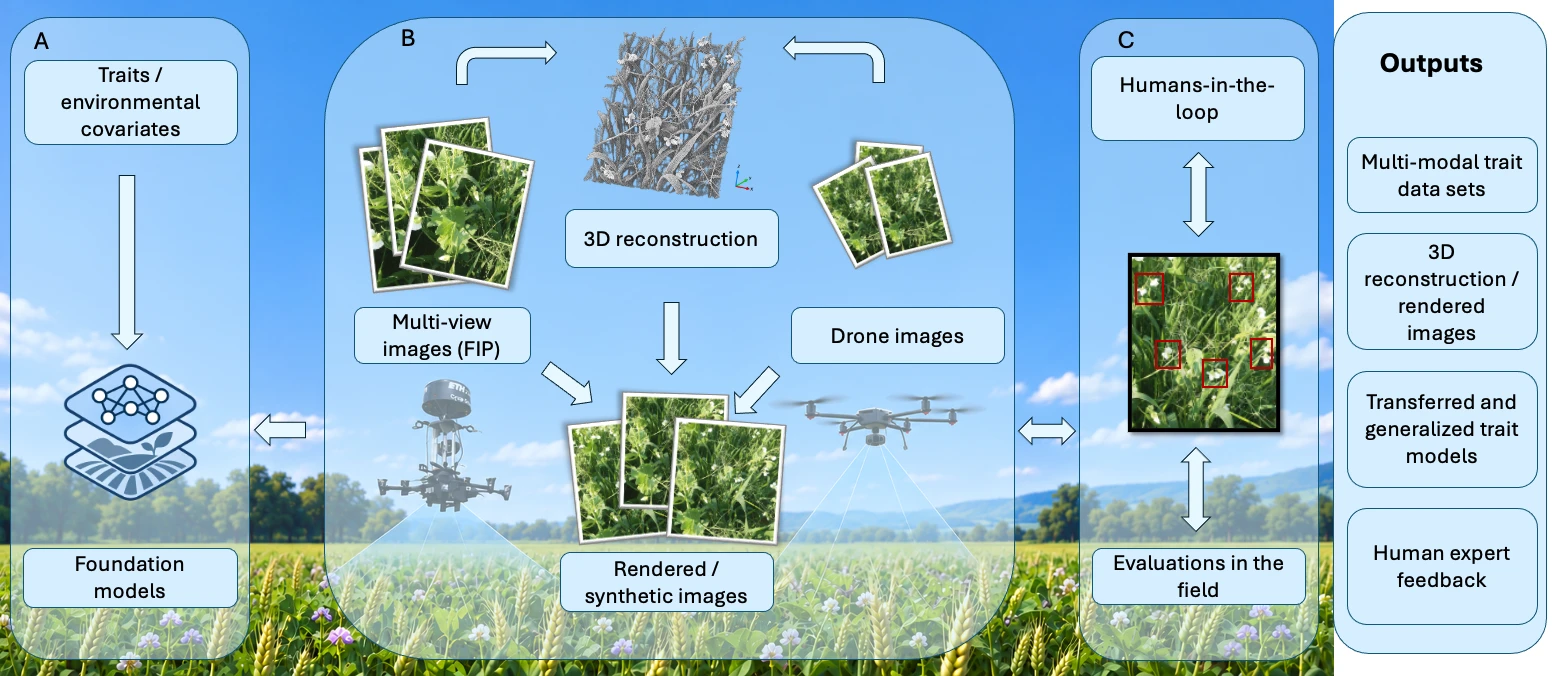
Figure 2: Overview of the project. Foundation models for automated plant trait estimation (A), multi-view imaging, 3D reconstruction, and synthetic image generation for domain transfer (B), human-in-the-loop strategies and field evaluations to improve model performance (C).
Impact
PhenoMix contributes to more sustainable and climate-resilient agriculture by supporting the identification of suitable cereal–legume variety combinations that improve resource use efficiency and crop productivity. By making advanced phenotyping methods accessible beyond specialized research platforms, the project facilitates large-scale monitoring of crops under diverse field conditions and supports data-driven decisions in crop breeding and agricultural management. Beyond these practical applications, PhenoMix provides openly accessible, multimodal time-series datasets and reusable machine learning methods, enabling further advances in plant phenotyping, crop modeling, and the study of plant–environment interactions. These resources create a foundation for future research and foster collaboration between data science, plant science, and agricultural research.
Presentation
Gallery
Annexe
Additional resources
Bibliography
- Eeuwijk, F. A. van, D. Bustos-Korts, E. J. Millet, M. P. Boer, W. Kruijer, A. Thompson, M. Malosetti, H. Iwata, R. Quiroz, C. Kuppe, O. Muller, K. N. Blazakis, K. Yu, F. Tardieu, and S. C. Chapman (May 1, 2019). “Modelling strategies for assessing and increasing the effectiveness of new phenotyping techniques in plant breeding”. In: Plant Science. The 4th International Plant Phenotyping Symposium 282, pp. 23–39. issn: 0168-9452. https://doi.org/10.1016/j.plantsci.2018.06.018
- Kiær, L. P., O. D. Weedon, L. Bedoussac, C. Bickler, M. R. Finckh, B. Haug, P. P. M. Iannetta, G. Raaphorst-Travaille, M. Weih, and A. J. Karley (2022). “Supply Chain Perspectives on Breeding for Legume–Cereal Inter- crops”. In: Frontiers in Plant Science 13. issn: 1664-462X. https://doi.org/10.3389/fpls.2022.844635
- Kirchgessner, N., F. Liebisch, K. Yu, J. Pfeifer, M. Friedli, A. Hund, and A. Walter (2017). “The ETH Field Phenotyping Platform FIP: A Cable-Suspended Multi-Sensor System”. In: Functional Plant Biology 44.1, p. 154. https://doi.org/10.1071/FP16165
- Rezaei, E. E., H. Webber, S. Asseng, K. Boote, J. L. Durand, F. Ewert, P. Martre, and D. S. MacCarthy (Dec. 2023). “Climate change impacts on crop yields”. In: Nature Reviews Earth & Environment 4.12, pp. 831–846. issn: 2662-138X. https://doi.org/10.1038/s43017-023-00491-0
Publications
More projects

NWF4CH: Neural Weather Forecasting

ALBUM

AICADES

IICU National Data Stream
More projects
News
Latest news

Quand l’IA soutient l’économie du canton de Vaud, la santé et l’environnement
Quand l’IA soutient l’économie du canton de Vaud, la santé et l’environnement

Elevating International Geneva's Impact with AI
Elevating International Geneva's Impact with AI
12 Zurich SMEs join next AI Innovation Program
12 Zurich SMEs join next AI Innovation Program
Contact us
Would you like to explore how we can work together?
Our team of data scientists and professionals looks forward to engaging in impactful, results-driven collaborations with you.