

AI-Driven Political Monitoring
Legislative tracking for labor advocacy at Kaufmännischer Verband Schweiz

Abstract
The Kaufmännischer Verband Schweiz (Swiss Association of Commercial Employees) is one of Switzerland's largest professional associations, representing the interests of employees in commercial, administrative, and business-related occupations. As part of its mandate, the association engages in political advocacy on labor policy, which requires continuous monitoring of parliamentary activity at the federal level. The Swiss Parliament publishes a comprehensive, multilingual record of business items, debates, status updates, and metadata dating back to 1978 under an open data policy. While this material is freely accessible, its sheer volume and complexity make systematic manual review impractical. Smaller and mid-sized nonprofits in particular lack the financial and personnel resources to track every legislative proposal, committee report, and parliamentary intervention that could affect the people they represent. As a result, political monitoring tends to be incomplete or selective, which weakens advocacy work where it matters most: detecting relevant developments early enough to respond to them.
In this project, we have developed an AI-based system that identifies parliamentary business relevant to labor policy, enabling advocacy organizations to monitor the political landscape with a fraction of the manual effort.

People
Collaborators

Paulina Körner joined the SDSC in September 2025 as a Data Scientist in the Innovation team in Zurich.
Paulina holds an MSc in Environmental Science from ETH Zürich and completed an MPhil in Machine Learning and Machine Intelligence at the University of Cambridge. She has worked as a data science intern in Alpine Remote Sensing and as a research assistant at ETH Zürich, where she focused on automating chemical risk evaluations. She also gained consulting experience at South Pole, supporting clients in designing decarbonization roadmaps. Paulina is particularly interested in interpretable machine learning and in applying AI to address real-world challenges in environmental science, industry, and the public sector.


Anna joined SDSC as a Data Scientist focusing on industry collaborations in July 2019. She completed her PhD in Bioinformatics at the University of Luxembourg, where she analysed large-scale heterogeneous datasets and leveraged multiple disciplines: Statistics, Network Analysis, and Machine Learning. Before joining SDSC, Anna worked as a Data Scientist at Deloitte Luxembourg, with a focus on computer vision and time-series analysis.Currently, Anna is a Principal Data Scientist based at the ETH Zurich office, where she leads biomedical collaborations with industry partners. Anna works on a range of projects: protein properties prediction, biomanufacturing optimization, statistical model evaluation and others.
PI | Partners:
Kaufmännischer Verband Schweiz
Dr. Ursula Häfliger
Enya Steimann
description
Objectives
The project set out to evaluate, and then demonstrate, whether modern natural language processing (NLP) and machine learning (ML) methods can automate political monitoring on publicly available Swiss parliamentary data. Working with the Swiss Association of Commercial Employees, the goals were to:
- Build an end-to-end pipeline that ingests parliamentary business items from the Swiss Parliament API, handles the multilingual nature of the data (German, French, Italian), and prepares it for analysis.
- Train a supervised classifier that reliably identifies parliamentary items relevant to labor policy, combining multilingual sentence embeddings with structured metadata features.
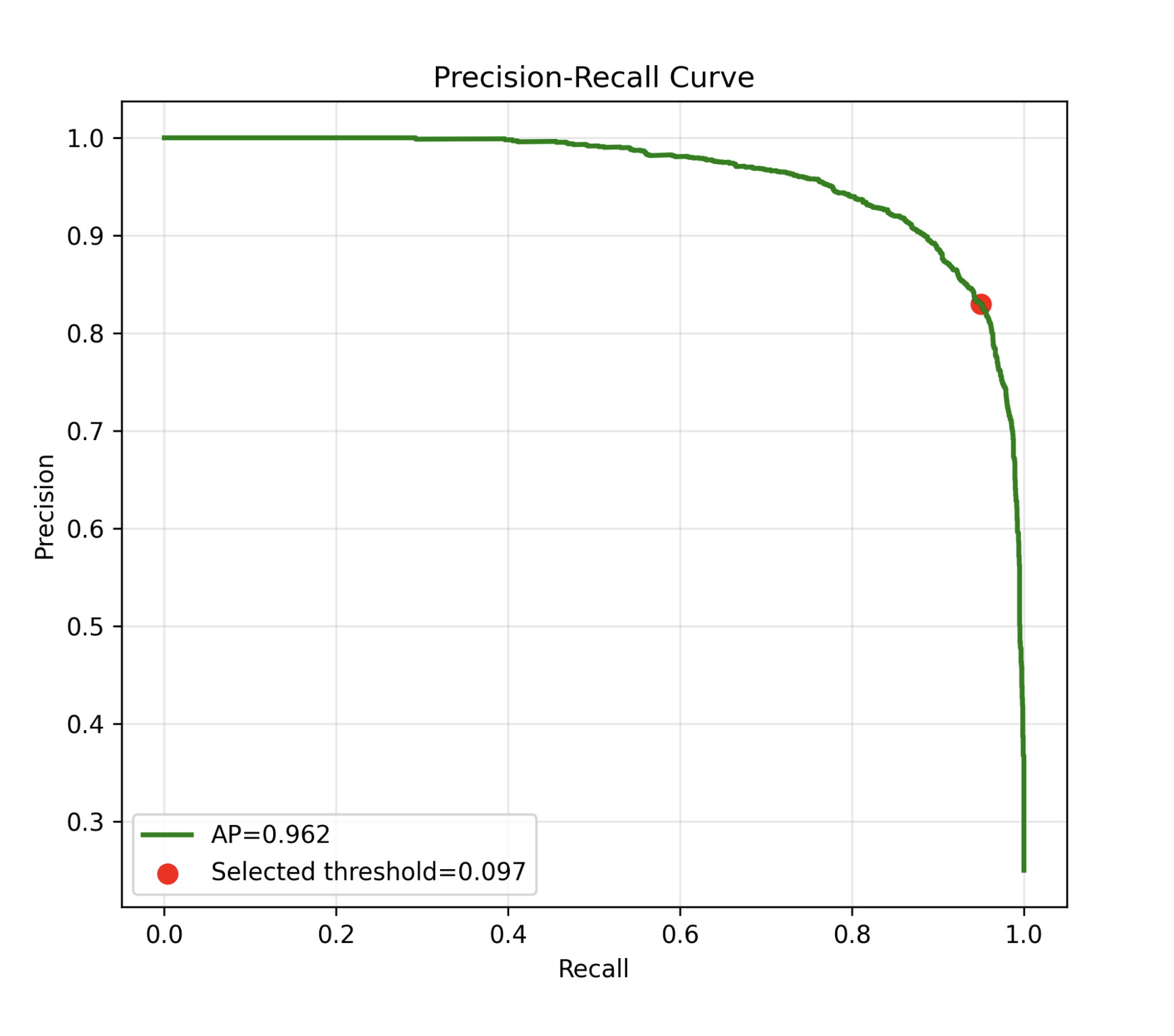
- Establish a configurable recall-precision operating point so that the organization can decide how much manual review effort to invest against how exhaustive coverage needs to be.
- Design a human-in-the-loop workflow in which domain experts review model output, feed corrections back into the training data, and trigger periodic retraining as political language and priorities evolve.
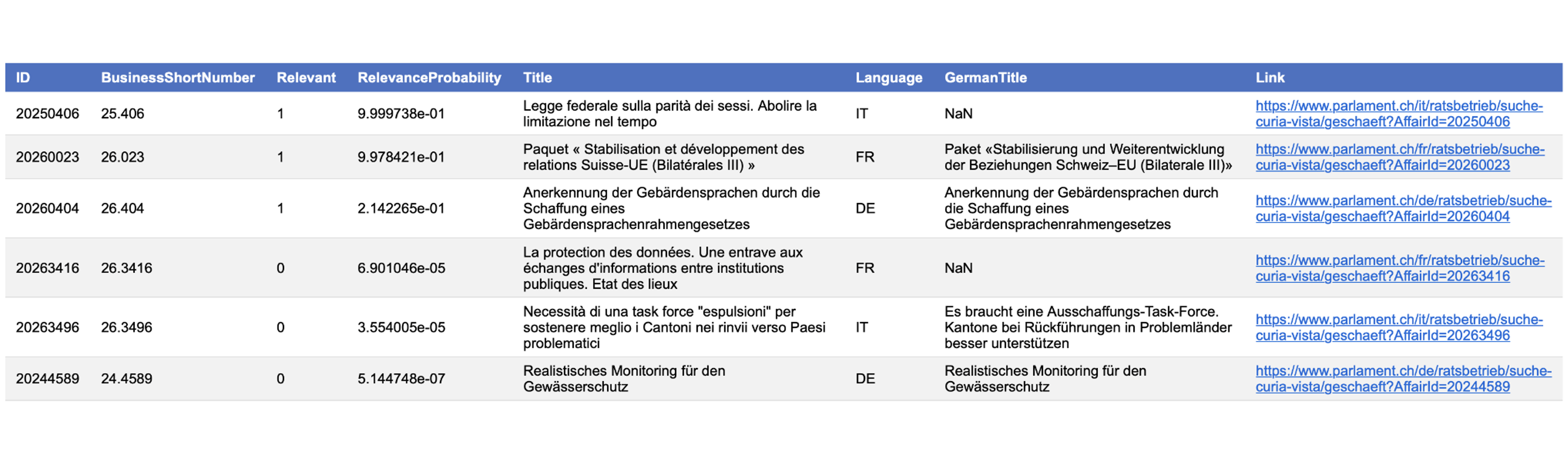
- Deliver daily, relevance-ranked outputs with direct links to the official parliamentary website, usable by non-technical advocacy staff without changing their existing workflow.
Benefits
The system substantially reduces the manual screening effort required to keep up with federal legislative activity, while maintaining high coverage of items that matter to labor policy. At the chosen operating threshold, the model achieves a balanced accuracy of 94% and a recall of 95%, meaning the large majority of non-relevant items are filtered out automatically, and very few relevant items are missed.
Predictions come with calibrated probability scores, so items can be ranked rather than just classified, allowing reviewers to focus their time where it has the most impact. Because the workflow is built around human feedback, expert judgment remains the source of ground truth, and the model continues to improve as more labelled examples accumulate. The result is a monitoring capability that previously required dedicated staff time and is now delivered as a daily report.
Presentation
Gallery
Annexe
Cover image source: Adobe Stock
Related pages
Additional resources
Bibliography
Publications
Related Pages
More projects

MOBIKO

SCOPE

I-DEEP-TRUST

ECOCLIM
More projects
News
Latest news

La science des données au service de la neutralité carbone du canton : ENERBAT ouvre la voie
La science des données au service de la neutralité carbone du canton : ENERBAT ouvre la voie
The SDSC to support 31 projects through its second National Calls
The SDSC to support 31 projects through its second National Calls
SDSC and PSI teams jointly explore the AI potential of large-scale infrastructures
SDSC and PSI teams jointly explore the AI potential of large-scale infrastructures
Contact us
Would you like to explore how we can work together?
Our team of data scientists and professionals looks forward to engaging in impactful, results-driven collaborations with you.