

MOBIKO
Mountain Biodiversity Knowledge Graph

Abstract
Much knowledge about mountain biodiversity is “trapped” inside scientific publications as unstructured text that is not machine-understandable and difficult to link and summarise. With advances in natural language processing, large language models, and computational power, unstructured text can increasingly be mined and relations between concepts explored and stored in a structured way as linked open data. Here we propose to develop the Mountain Biodiversity Knowledge Graph ‘MoBiKo’, by extracting knowledge about mountain biodiversity status and trends from literature and store it in a graph database for analysis in the context of a first ever global mountain biodiversity assessment.
The project builds on existing biodiversity knowledge infrastructures and databases, rule-based approaches, and on artificial intelligence, machine learning, and natural language processing tools. It delivers a state-of-the-art machine-based approach to knowledge and relation extraction applicable beyond the mountain context. MoBiKo will allow users to query, analyse, and visualise mountain biodiversity status and trends information in space and time and to access and manipulate linked data in support of open and collaborative science and policy. As a collaborative project with existing open research data initiatives and by adopting FAIR principles, this project contributes to, and benefit from open science in Switzerland and beyond.
People
Collaborators

Yousra studied Mathematics and Computational Statistics. She did a PhD in Statistical Learning followed by a post-doc both at EPFL, where she developed empirical Bayes methods for automatic L2 regularization problems in smooth regression for big data. Before joining SDSC, she worked at SIB/UNIL, where she developed a statistical optimization solution to the parent-of-origin identification problem in human genetics. Her technical expertise includes supervised learning, numerical optimization for machine learning, statistical modeling and methodology, high-performance and distributed computing for big data, Bayesian computation and time series analysis. She worked on applied problems in quantitative finance and environmental sciences.



Carl holds a Ph.D in Mathematics from École des Ponts ParisTech and Université Gustave Eiffel in Paris. He has broad interests in statistics and stochastic control, and works on reinforcement learning, generative methods and time series forecasting, with applications in various domains such as energy, finance and physics. He worked with EDF R&D and Finance des Marchés de l’Energie (FiME) laboratory on applications of machine learning to risk management, including time series generation and deep hedging. He joined the SDSC in 2022 as a senior data scientist in the academic team at École Polytechnique Fédérale de Lausanne (EPFL).

Anisia Katinskaia joined the SDSC in August 2025 as a Senior Data Scientist in the Research team in Lausanne.
Anisia is an NLP researcher with a PhD in Computer Science from the University of Helsinki, Finland. She also holds a Master's degree in Computational Linguistics from the Russian State University for the Humanities. Anisia's research has primarily focused on applying NLP to education, particularly in the context of the development of Revita, an online Intelligent Tutoring System for language learning. During her time at the University of Helsinki, she worked on grammatical error detection and correction, text difficulty estimation, text simplification, low-resource NLP, model interpretability via probing, tokenization for language models, and the development of educational LLM-based agents.

Luis is originally from Spain, where he completed his bachelor's studies in Electrical engineering, and the Ms.C. on signal theory and communications, both at the University of Seville. During his Ph.D. he started focusing on machine learning methods, more specifically message passing techniques for channel coding, and Bayesian methods for channel equalization. He carried it out between the University of Seville and the University Carlos III in Madrid, also spending some time at the EPFL, Switzerland, and Bell Labs, USA, where he worked on advanced techniques for optical channel coding. When he completed his Ph.D. in 2013, he moved to the Luxembourg Center on Systems Biomedicine, where he switched his interest to neuroscience, neuroimaging, life sciences, etc., and the application of machine learning techniques to these fields. During his 4 and a half years there as a Postdoc, he worked on many different problems as a data scientist, encompassing topics such as microscopy image analysis, neuroimaging, single-cell gene expression analysis, etc. He joined the SDSC in April 2018. As Lead Data Scientist, Luis coordinates projects in various domains. Several projects focus on the application of natural language processing and knowledge graphs to the study of different phenomena in social and political sciences. In the domains of architecture and engineering, Luis is responsible for projects centered on the application of novel generative methods to parametric modeling. Finally, Luis also coordinates different projects in robotics, ranging from collaborative robotic construction to deformable object manipulation.
PI | Partners:
Global Mountain Biodiversity Assessment (GMBA), PLAZI, Swiss Institute of Bioinformatics
Global Mountain Biodiversity Assessment (GMBA)
- Prof. Markus Fischer
- Prof. Antoine Guisan
- Dr. Donat Agosti
- Prof. Patrick Ruch
description
Motivation
The corpus of scientific literature is growing exponentially, approaching 500 million pages for biodiversity. Accordingly, reviewing or synthesizing it is close to impossible without technological support. Yet, because most literature consists of non-machine-readable unstructured text, the knowledge it contains is ‘trapped’ and its analysis limited. Advances in artificial intelligence (AI) and NLP represent a game changer towards ‘liberating’ these data. Despite these developments, no solution exists yet for the machine-based processing of extensive biodiversity literature and for supporting large-scale assessments with readily available knowledge repositories. Our project is an attempt to address this situation by applying and further evolving AI approaches for meaning and relationship extraction.
Proposed Approach / Solution
The Swiss Data Science Center (SDSC) contributes to the MoBiKo project by designing and implementing a robust, scalable pipeline that transforms unstructured biodiversity literature into structured, machine-interpretable knowledge. Our mission in this project is to bridge advances in natural language processing, knowledge representation, and graph technologies with the concrete needs of large-scale biodiversity assessment. SDSC leads the development and evaluation of state-of-the-art named entity recognition and relationship extraction methods, combining transformer-based models, large language models, and ontology-driven normalization to extract biodiversity states, trends, and drivers from scientific texts. These extracted statements are formalized as traceable RDF entities and relations and integrated into an interoperable knowledge graph aligned with FAIR principles. Throughout the project, SDSC works closely with domain experts and existing biodiversity infrastructures to ensure methodological rigor, transparency, and reusability, while delivering a generalizable approach applicable beyond the mountain biodiversity domain.
Impact
The project delivers a step change in how biodiversity knowledge can be accessed, assessed, and reused by converting thousands of publications into a structured, transparent, and queryable knowledge graph. Scientifically, this reduces the reliance on purely manual literature synthesis and enables reproducible, large-scale assessments of biodiversity trends and drivers. Societally, the resulting infrastructure supports evidence-based environmental policy and leaves a durable open resource for researchers, practitioners, and decision-makers.

Figure 1. Overview of the research plan and WPs. Italics: processes, boxes: inputs / outputs.
Presentation
Gallery
Annexe
Additional resources
Bibliography
- Wilkinson, M. D. et al. The FAIR Guiding Principles for scientific data management and
stewardship. Sci Data 3, 160018 (2016). - Page, R. D. M. Ozymandias: a biodiversity knowledge graph. PeerJ 7, e6739 (2019).
- Thessen, A. E., Cui, H. & Mozzherin, D. Applications of Natural Language Processing in
biodiversity science. Advances in Bioinformatics 2012, 1–17 (2012). - Dagdelen, J. et al. Structured information extraction from scientific text with large language
models. Nat Commun 15, 1418 (2024). - Penev, L. et al. OpenBiodiv: a knowledge graph for literature-extracted Linked Open Data in
biodiversity science. Publications 7, 38 (2019).
Publications
Related Pages
More projects

SCOPE

I-DEEP-TRUST

ECOCLIM

Merck: cancer care adverse events
More projects
News
Latest news

La science des données au service de la neutralité carbone du canton : ENERBAT ouvre la voie
La science des données au service de la neutralité carbone du canton : ENERBAT ouvre la voie
The SDSC to support 31 projects through its second National Calls
The SDSC to support 31 projects through its second National Calls
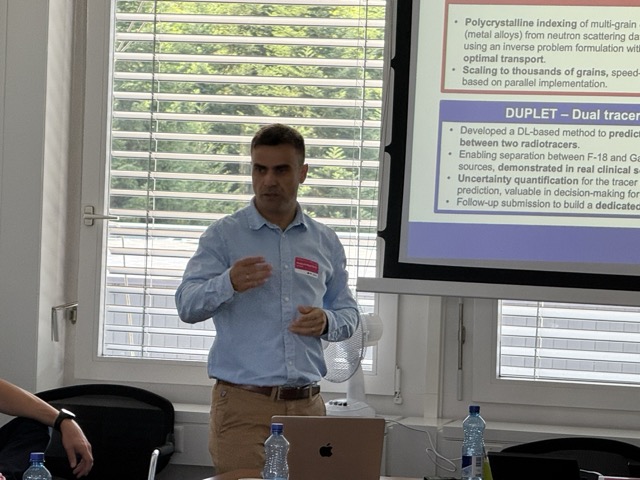
SDSC and PSI teams jointly explore the AI potential of large-scale infrastructures
SDSC and PSI teams jointly explore the AI potential of large-scale infrastructures
Contact us
Would you like to explore how we can work together?
Our team of data scientists and professionals looks forward to engaging in impactful, results-driven collaborations with you.