

Timeseries Forecasting for Business Impact
Supporting Zurich SMEs in operational efficiency and decision-making

Abstract
As part of the Canton Zurich SME AI Program (2025 edition), two companies - GoNina and Bachmann Krawatten AG - explored how integrating forecasting with customer data and AI can create measurable business impact. While the two companies are at different stages of AI adoption, both face time-sensitive business challenges where more accurate predictions lead directly to better decisions.
For Bachmann Krawatten AG, the focus was on using survival analysis to predict when customers of corporate fashion are likely to place their next order and to prioritize sales outreach. In the case of GoNina, the goal was refining demand forecasting across irregular bakery sales data to minimize food waste. The result is a proof-of-concept that demonstrates how progress in applied machine learning depends on continuous iteration, data quality, and aligning technical models with operational constraints.
People
Collaborators

Oliver Poole joined the SDSC in December 2025 as Data Scientist for the Innovation team, based in Zurich.
Prior, Oliver completed his bachelor's and master's degrees in mechanical engineering from ETH Zurich, with research on custom 3D-printed metallic springs for (non-)linear stiffness customization and reinforcement learning applications in control systems. He developed anomaly detection systems for X-ray images of mechanical parts, milk foam quality assessment using computer vision and sensor data, and data-driven flow control strategies and extraction consistency for coffee machines. His work bridges physical engineering intuition with machine learning, focusing on robust models that connect sensor data directly to measurable outcomes in industrial systems.


Anna joined SDSC as a Data Scientist focusing on industry collaborations in July 2019. She completed her PhD in Bioinformatics at the University of Luxembourg, where she analysed large-scale heterogeneous datasets and leveraged multiple disciplines: Statistics, Network Analysis, and Machine Learning. Before joining SDSC, Anna worked as a Data Scientist at Deloitte Luxembourg, with a focus on computer vision and time-series analysis.Currently, Anna is a Principal Data Scientist based at the ETH Zurich office, where she leads biomedical collaborations with industry partners. Anna works on a range of projects: protein properties prediction, biomanufacturing optimization, statistical model evaluation and others.
PI | Partners:
Canton of Zurich | Department of Economics:
Markus Müller
Raphael von Thiessen
Chantal Stäuble
Anna Zakharova
description
Motivation
The central question driving this collaboration was: How can we leverage customer data, machine learning and AI-driven forecasting more effectively to improve operational decision-making?
To address this, the program paired the two companies at opposite ends of the AI adoption spectrum, transforming their differences in maturity into an opportunity for collaboration and mutual learning. Bachmann Krawatten AG was embarking on its first AI-supported engagement project, while GoNina sought to refine a complex forecasting system already in production.
This partnership created a knowledge-sharing environment where the companies didn't just work in parallel, but actively challenged each other’s assumptions. By comparing a newly developed prototype with a mature AI-driven forecasting system, the participants identified four fundamental areas where technical innovation and business priorities must align to achieve scalable business impact:
- Business-Aligned Evaluation Metrics: Defining use-case-specific evaluation metrics that go beyond standard model accuracy to reflect actual business value and guide operational decision-making.
- Data Quality and Feature Engineering: Assessing how data quality, feature selection and feature engineering influence model performance and robustness, particularly in the presence of sparse or irregular data.
- Operational Sustainability / MLOps and Lifecycle Management: Establishing the monitoring, infrastructure and governance processes required to sustain model performance, detect drift, and ensure reliable operation in production environments.
- Data-Driven Decision-Making Culture: Exploring how a deeper understanding of transactional and operational data can shift an organization’s mindset enabling more proactive, evidence-based decision-making in operations.
Solution
The project developed two distinct technical pathways under a shared learning framework, utilizing a Python-based stack, including Lifelines Library to perform survival analysis, GitHub for version control, and the SDSC’s open-source code-and-compute platform Renku to enable reproducible environments.
- Track 1: Customer Re-Order Modelling (Bachmann Krawatten AG): To support the sales team in prioritizing outreach, the team framed re-order behaviour as a survival analysis problem. Interpretable baseline statistical models including Cox Proportional Hazards, Weibull AFT (Accelerated Failure Time), and Log-Normal AFT were compared against a more complex Random Survival Forest (RSF). As shown in Table 1, simple interpretable models such as the Weibull AFT consistently matched or outperformed the more complex RSF across all metrics, while requiring lower computational resources and producing outputs that non-technical stakeholders can directly act on. This emphasized that simple models provide a robust foundation at lower computational cost and with clearer business transparency.
- Track 2: Food Waste Minimization (GoNina): The team reviewed GoNina’s existing pipeline to better capture demand drivers, such as school holidays and cannibalization effects from promotional products. While classical SARIMA (Seasonal Auto Regressive Integrated Moving Average) models captured some seasonality, the project identified representation-learning models, in particular variational Autoencoders, as a promising next step for modeling timeseries points and holiday-related anomalies in heterogeneous bakery data.
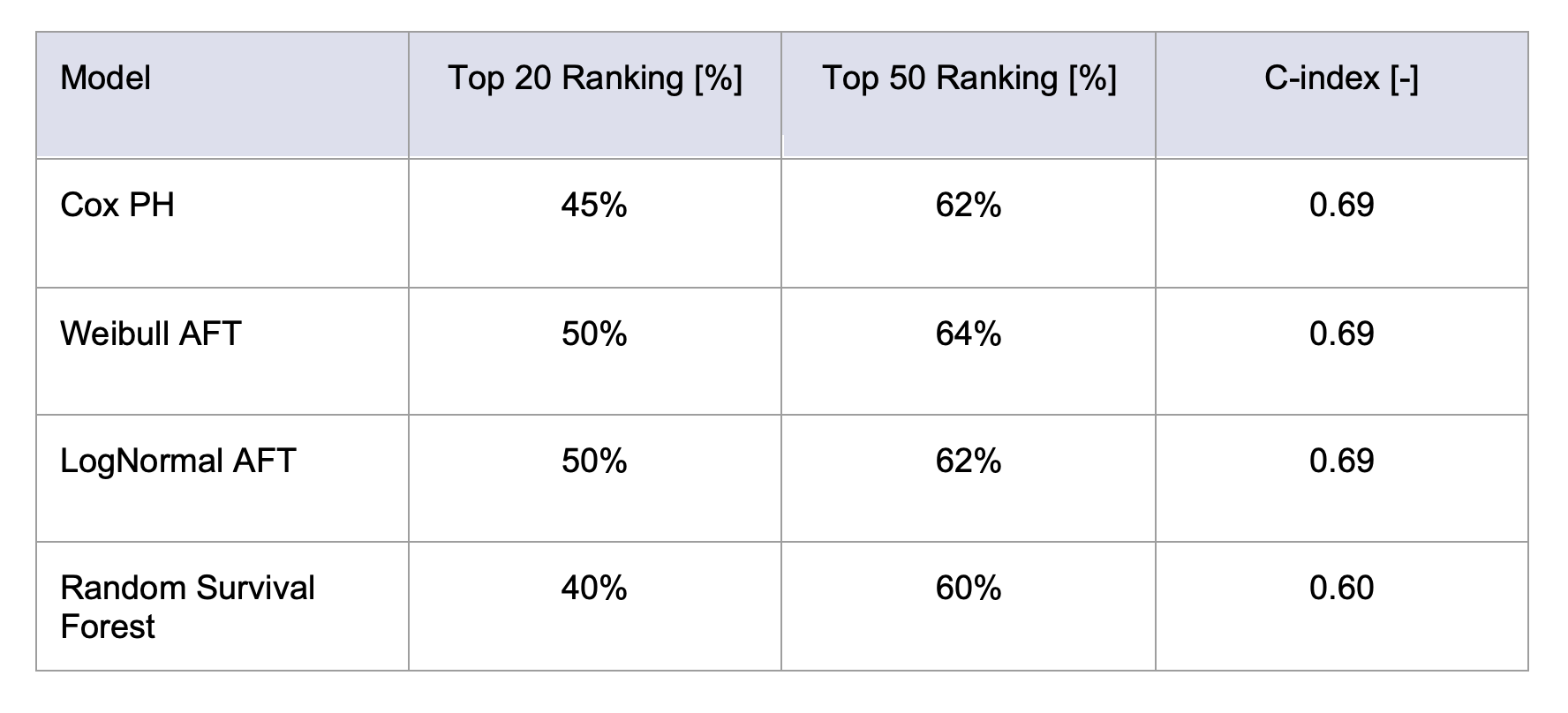
Table 1: Modelling results from the forecasting project using different survival analysis models. Weibull AFT consistently ranked highest, although the results were close across all other models. The RSF model performed worst across all metrics, despite being the most feature-rich and complex model.
Impact
The project demonstrated thatprioritizing simple, interpretable models over excessive technical complexityleads to faster deployment and more transparent decision-making.
Key outcomes included:
- Business-Aligned Metrics: The shift from generic accuracy to use-case-specific metrics (likeRecall@k) ensured that model performance is measured by its actual contributionto sales and waste reduction.
- Operational Infrastructure and Model Performance Monitoring: Deploying a model is not the finishing line. Sustained performance requires dedicated IT oversight, regular retraining, and a clear process for detecting when a model's outputs no longer reflect current business reality.
- Providing a Cultural Blueprint: Demonstrating how SMEs, regardless of their starting point, can transform raw data into actionable insights, fostering a data-driven culture that enables proactive decision-making and continuous business improvement.
- Data Matters more than Algorithm Complexity: Data quality and the ability to extract meaningful insights are often more important than using the most advanced AI algorithms. When data is limited, irregular, or incomplete, simpler models frequently deliver the best initial results because they are more robust and easier to trust. More sophisticated models can ultimately achieve a higher performance, but only when the underlying data is enriched with the right business-relevant information.
This collaboration reinforced that building an operational AI solution is not a one-time technical project, but an ongoing process of learning, adaption, and refinement. Achieving lasting value requires organizational commitment, investment in data infrastructure, and a focus on measuring progress through business outcomes rather than on technical performance metrics alone.
Open-source code available
The prototype is published as open-source code and maintained by the SDSC on GitHub:
https://github.com/SwissDataScienceCenter/sme-kt-zh-collaboration-forecasting
Presentation
Gallery
Annexe
Additional resources
Bibliography
Publications
More projects

Merck: cancer care adverse events
Èvokâ: Enhancing Fribourg's Archives
ACROSS

Dedgeflow
More projects
News
Latest news

La science des données au service de la neutralité carbone du canton : ENERBAT ouvre la voie
La science des données au service de la neutralité carbone du canton : ENERBAT ouvre la voie
The SDSC to support 31 projects through its second National Calls
The SDSC to support 31 projects through its second National Calls
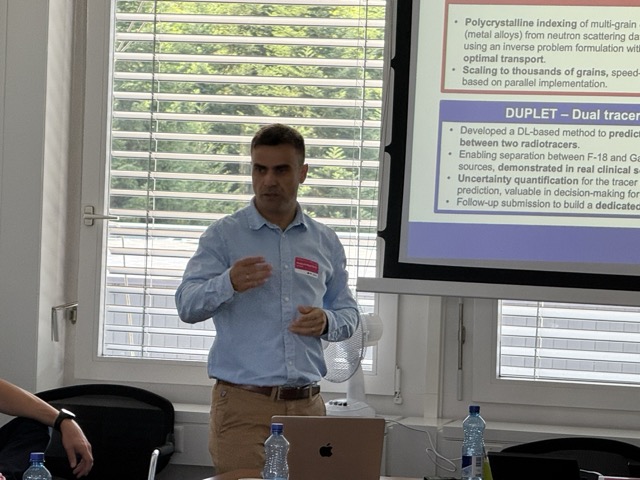
SDSC and PSI teams jointly explore the AI potential of large-scale infrastructures
SDSC and PSI teams jointly explore the AI potential of large-scale infrastructures
Contact us
Would you like to explore how we can work together?
Our team of data scientists and professionals looks forward to engaging in impactful, results-driven collaborations with you.